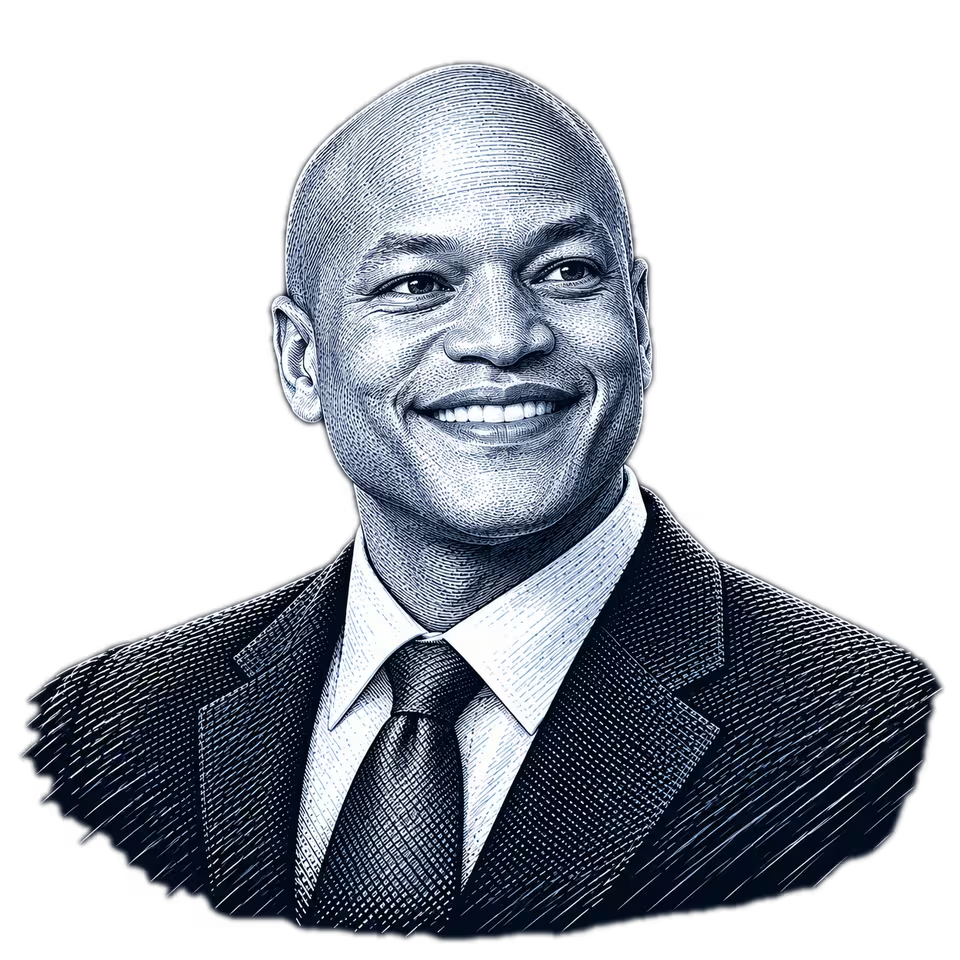
Democrat · Maryland governor · 2026
Wes Moore
Moore was three when his father died, and his family moved to the Bronx to live with his grandparents.
Biography
Wes Moore was three when his father died, after which his mother moved the family from Maryland to the Bronx to live with his grandparents.1 He later returned to Maryland, and he and his wife, Dawn, have two children, Mia and James.1
Moore graduated from Valley Forge Military College and Johns Hopkins before studying at Oxford as a Rhodes Scholar.1 He served in Afghanistan with the Army's 82nd Airborne Division and worked in finance before founding BridgeEdU, a business helping students make the transition into college.1 From 2017 to 2021, he led the Robin Hood Foundation, which funds efforts to reduce poverty.1
Elected in 2022, Moore became Maryland's first Black governor and took office in January 2023.1 He signed the Fair Wage Act in 2023, accelerating the state's move to a $15 minimum wage to January 2024.2 He also signed the SERVE Act, creating a state supported service year option focused on service, training and mentorship.3
Moore seeks a second term against Republican Dan Cox in a rematch of 2022, with other candidates also on the ballot.4 His proposals emphasize more affordable housing, action against price gouging and access to rural healthcare, setting out his approach to household costs and economic opportunity.4
Record and controversies
Bronze Star application and defamation suit
Moore's 2006 White House fellowship application said he had received a Bronze Star when the award had not been issued.5 He apologized for not correcting the record, and his former commander said he had encouraged Moore to list the anticipated honor.5 The Army subsequently awarded the medal in 2024, so it is inaccurate to say he has never received it.5
David Smith, owner of the Baltimore Sun and chairman of Sinclair, sued Moore over comments linking Smith to Jeffrey Epstein's investment in Sinclair.6 Smith said purchases of public company shares did not establish a personal relationship; Moore's attorneys sought dismissal based on privilege and immunity.6 In October, the state approved up to $50,000 for his defense, explaining that the suit concerned speech in his official role.6 The cited account describes a civil lawsuit and defense motion, not a finding that Moore committed defamation.6